Biography of st thomas aquinas philosophy slideshare
5 ways of st thomas aquinas 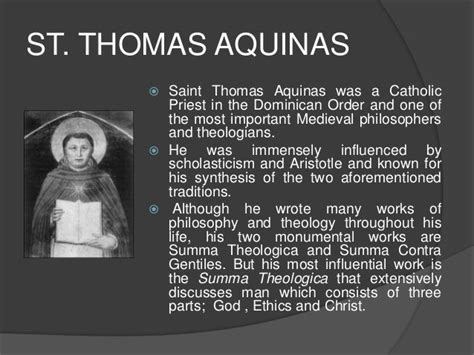
Interesting facts about st thomas aquinas St. Thomas Aquinas ( )
2. St. Thomas Aquinas ( ) Aquinas came from a noble family from Naples. He joined the Dominican order against his family’s wishes. Aquinas studied with Albert the Great in Paris and participated in the Aristotelian revival of the Middle Ages. He was canonized and became a saint in Resisting the temptation of a prostitute and the discovery of Herring at night were the miracles used to justify his sainthood. Aquinas’s extensive corpus of scholarship is perhaps a greater miracle than those mentioned above. 4. • Known as the greatest Christian medieval theologian-philosopher, he single-handedly stemmed the tide of Islamic Aristotelianism into Europe • His friends playfully called him “the dumb ox” • He produced over ninety works in a little over two decades • Summa Theologica • Summa Contra Gentiles • The Ways of God: For Meditation and Prayer • He stands at the top of the group of thinkers known as Scholastics • At age 48 he suddenly stopped writing • Maybe he suffered a brain hemorrhage • Maybe he had a vision that academic learning was not the most important thing • “All that I have written seems like straw to me,” he told a friend • A year later, he died on the road to a church council 5. Aquinas was dubbed “the dumb ox” by his fellow students, for being large and quiet. He was apparently quiet because he was busy thinking; he became the Catholic church’s top theologian, a title he still holds today, without dispute. 6. Aquinas’s major work, the Summa Theologica, is divided into 4 parts. Prima Pars (1st Part) Existence and Nature of God Prima Secundae (1st Part of the 2nd Part) Happiness, Psychology, Virtues, Law (Human, Natural, Divine) Secunda Secundae (2nd Part of the 2nd Part) The virtues in detail Tertia Pars (3rd Part) Christian Doctrine 7. The political philosophy of Thomas Aquinas, along with the broader philosophical teaching of which it is part, stands at the crossroads between the Christian gospel and th Vintage elegant st thomas aquinas philosophy slides St. Thomas Aquinas Philosophy
2. ST. THOMAS AQUINAS Saint Thomas Aquinas was a Catholic Priest in the Dominican Order and one of the most important Medieval philosophers and theologians. He was immensely influenced by scholasticism and Aristotle and known for his synthesis of the two aforementioned traditions. Although he wrote many works of philosophy and theology throughout his life, his two monumental works are Summa Theologica and Summa Contra Gentiles. But his most influential work is the Summa Theologica that extensively discusses man which consists of three parts; God , Ethics and Christ. 3. IN THOMISTIC PHILOSOPHY Man is substantially body and soul. The soul is united with the human body because it is the substantial form of the human body. It is the principle of action in the human body and the principle of life of the body. But the soul however, requires the body as the material medium for its operation particularly perception. Soul has operative functions which do not need a material medium; they are the man’s intellect and will. Thus at death, intellection and will remain in the soul which is immortal, simple and incorruptible. Body and soul before death are essentially united because the two exist in a correlative manner. 4. WORKS No single work of St. Thomas can be said fully to reveal his philosophy. His works may be classified according to their form and purpose. The principal ones are: Commentary in the Sentences (a series of public lectures; –56), his earliest great work; seven quaestiones disputatae (public debates; –72); philosophical commentaries on Aristotle's Physics, Metaphysics, De anima, Ethics, part of theDe interpretatione, and the Posterior Analytics; treatises on many subjects, including the Summa contra Gentiles (–60); and, most important of all, Summa theologica (–73), an incomplete but systematic exposition of theology on philosophical principles. St. Thomas's philosophy is avowedl St thomas aquinas
1. St. Thomas Aquinas AD 2. He was a member of the Dominican Order. Founded on the philosophical system of Aristotle, on the concept of natural law, and on Christian theology to forge "Thomism," a mighty synthesis of philosophy, theology and the sciences of man. 3. St. Thomas's student nickname was the Dumb Ox. He was also known as the Angelic Doctor. One of the 33 Doctors of the Church, he is considered by many Catholics to be the Church's greatest theologian and philosopher. 4. 2 best-known works Summa Theologica Summa Contra Gentiles 5. It was the Summa, more than any other work, that was to establish Thomism as the mainstream of Catholic scholastic theology in centuries to come. In the Summa Theologica, he considered in great detail five reasons for the existence of God. These are widely known as the quinque viae, or the "Five Ways." 6. Five Ways The series of motion necessitates a first mover. The series of cause and effect requires a first efficient cause. The contingency of beings necessitates a non- contingent being to bring forth existence. The degrees of perfection point to a perfect being who has the maximum of all positive qualities. The order and beauty visible in the world requires an intelligent designer. 7. St. Thomas was clearly an Aristotelian in adopting the latter's trenchant view of man but acquires an specific character in combination with the Christian thought. His view of man: Man is a rational being. Man is a substantial unity of body and soul. 8. A human body is actual, perfect and subject to animation that will enable it to perform its intrinsic functions as a human body. The soul is the animator of the human body and it is united to the human body for its lower activity (i.e. sensation). It is incorporeal (therefore immaterial) and spiritual. 9. The body ties the man to the material world while the soul ties the man to the spi The philosophy of st thomas aquinas Saint thomas aquinas
1. By: Niala, Francis 2. an Italian Dominican Friar and Catholic Priest an immensely influential Philosopher, Theologian and Jurist in the tradition of Scholasticism Also known as “Doctor Angelicus” and “Doctor Communis” Foremost classical proponent of Natural Theology “Father of Thomism” A Saint, A Model teacher Doctor of the Church (Catholic Church’s greatest Theologian & Philosopher) 3. “Before St. Thomas Aquinas was born, a holy hermit shared a prediction with his mother, foretelling that her son would enter the Order of Friars Preachers, become a great learner and achieve unequaled sanctity.” 4. Born on January 28, in Roccasecca, Kingdom of Sicily(Lazio Region), Italy Landulph –his father, a count of Aquino Theodora- his Mother, a countess of Teano Youngest among 8 siblings 5. Early education at the age of 5 in the Abbey of Monte Casino to train among the Benedictine monks “A witty child who had received a good soul”(Wisdom ) “ What is God to His Benefactors?” C. he was enrolled in University of Naples wherein he was introduce to the works of Aristotle, Averroes and Maimonides At 19yrs old he secretly joined the Dominican Order (John of St. Julian) On his way to Rome, He was kidnapped by his brothers and held him as captive in the fortress of San Giovanni Campano Attempts to deprogram Thomas from his new Beliefs Education 6. St. Thomas Aquinas continued to pursue his studies on to , with the Dominicans in Naples, Paris and Cologne and subsequently earned his Doctorate in Theology under the tutelage of Albertus Magnus In , He was Ordained in Cologne, Germany and went on to teach Theology in University of Paris. He proved an exemplary scholar, though, ironically, his modesty sometimes led his classmates to misperceive him as dim- witted (stupid/silly). St. Albert the Great on Thomas’s thesis, "We call this young man a dumb ox, but his bellowing in doctrine will on